Designing for recovery across the data sources vertical
Senior product designer at Rubrik.
I joined Rubrik in May 2025 and design how customers back up and recover databases and cloud data across Azure DevOps, MongoDB, Db2, GCP BigQuery, and the InterSystems IRIS platform.
The work spans shipped product and active design. I focus on the recovery model first: what customers need to restore, how the system should show scope and drift, and how to make risk legible before an irreversible action.
These five threads cover DevOps protection, AI tooling, IRIS, MongoDB, and GCP BigQuery. Each section labels its delivery status.
Making DevOps recovery match the user's intent
Backup and recovery across Azure DevOps and GitHub.
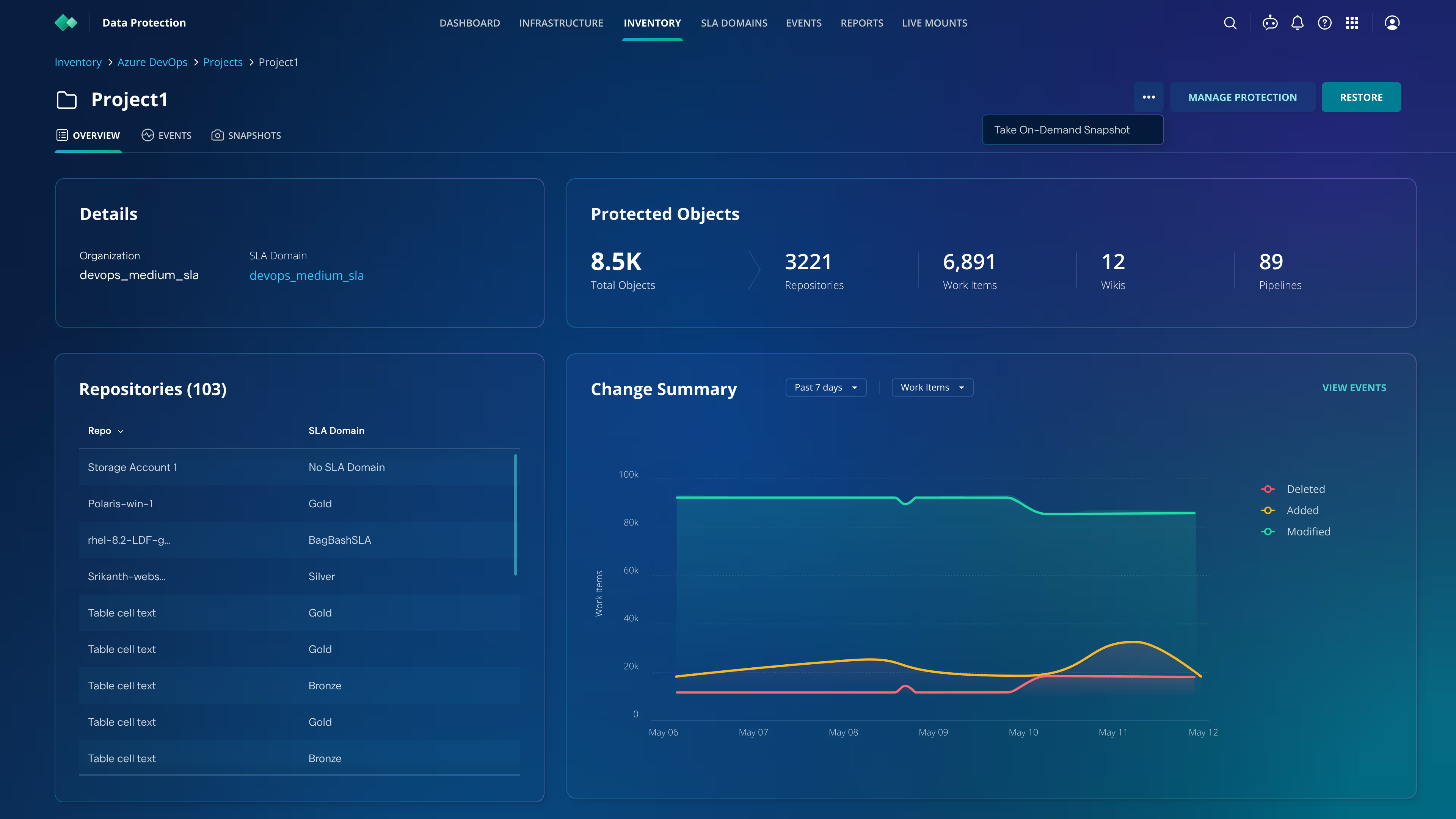
A DevOps project includes repositories, work items, boards, wikis, test plans, and pipelines. Protecting the repository alone does not restore the project people recognise, so we designed backup and recovery around the whole project.
At launch, the repository and pipeline layer protected more than 21,000 repositories across 50 customers. The non-repository layer, which I named Project Assets, is the part I designed most deeply.
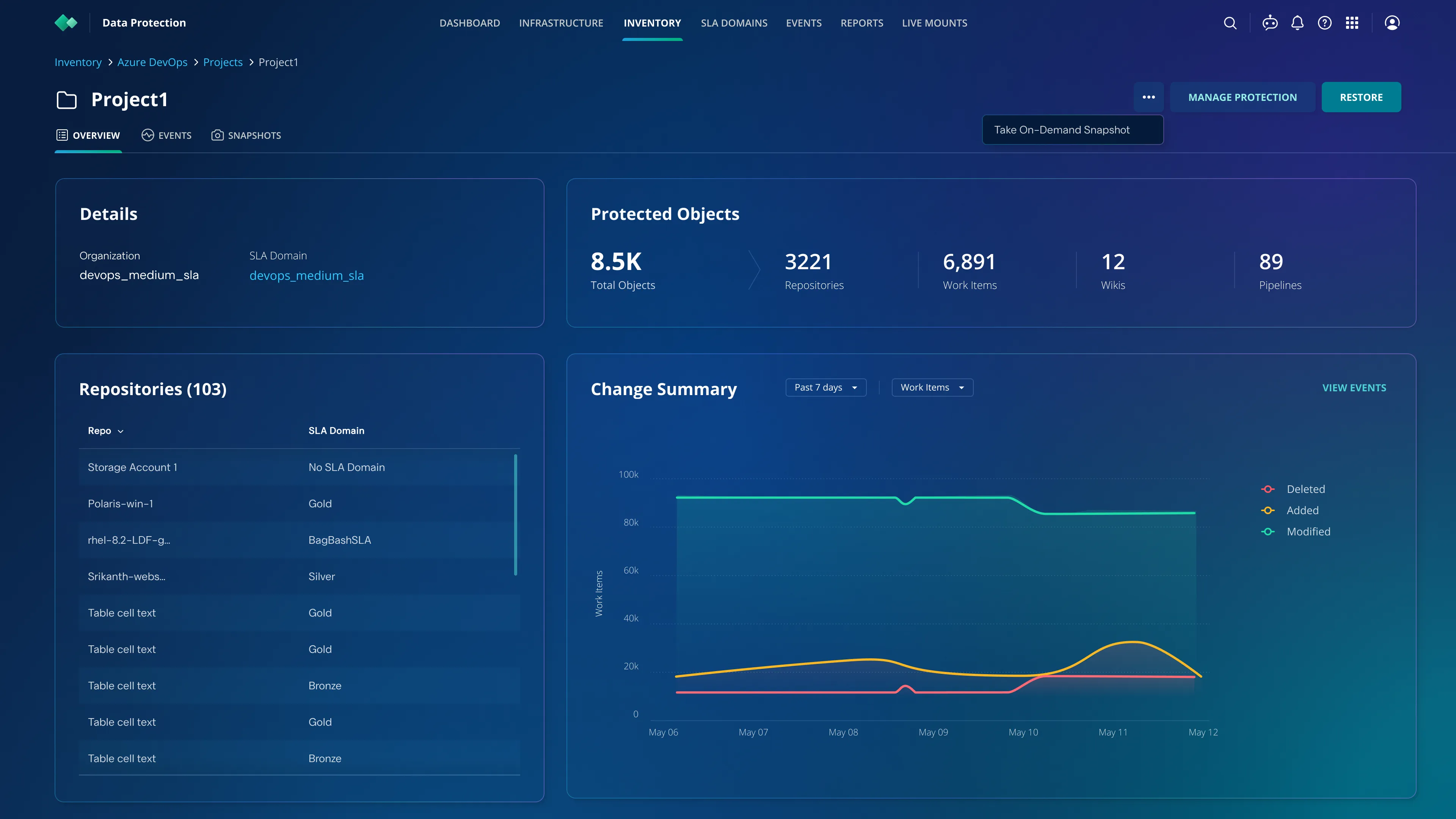
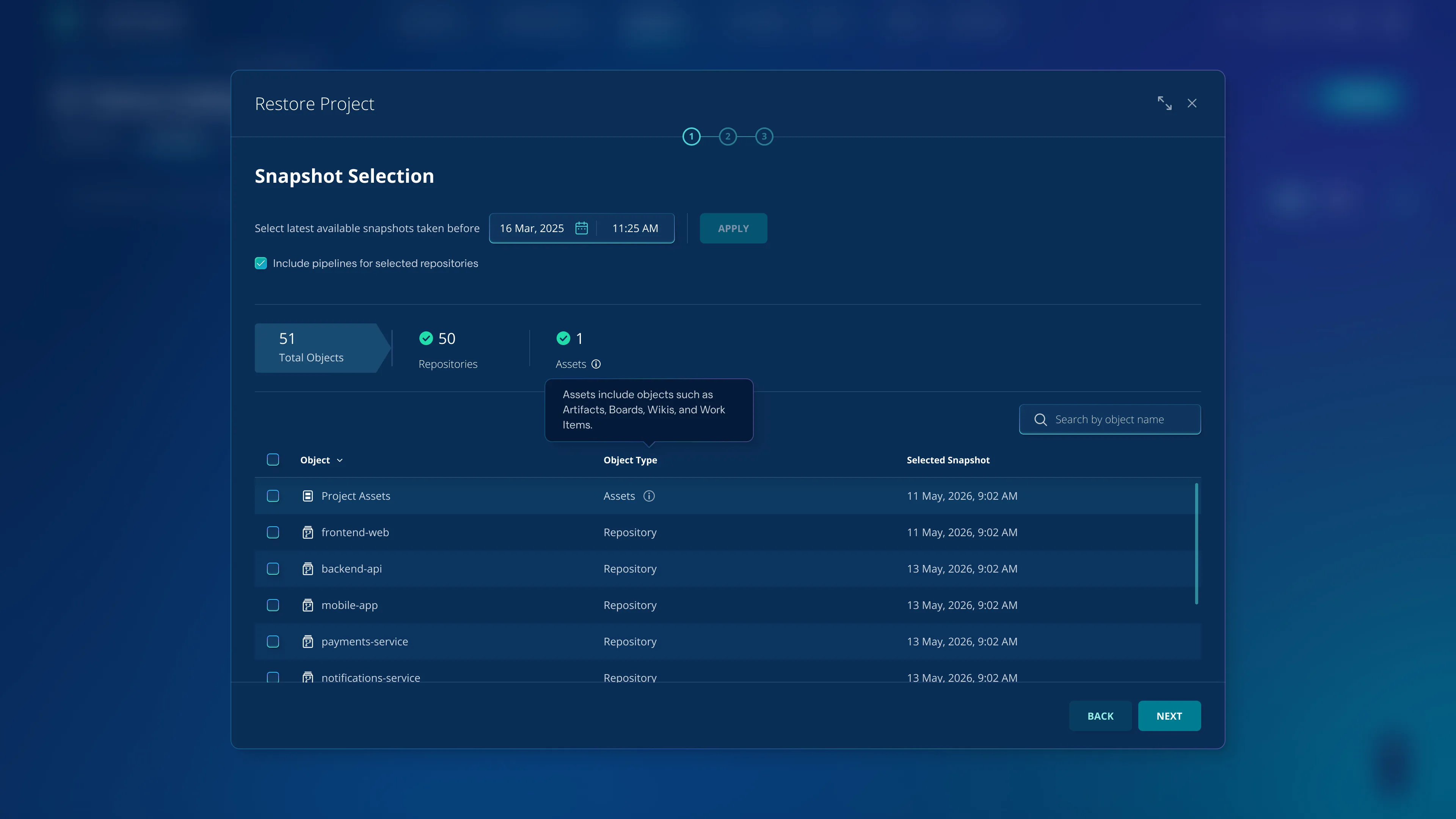
I made Restore the primary action and replaced a backup-jobs view with a change-summary chart. The snapshot picker shows drift per item, since repositories and assets run on separate schedules. That makes the recovery decision about the intended project state rather than a timestamp.
Finding existing patterns before designing new ones
Codebase-native tooling for faster design research.
Rubrik Security Cloud is large. Before designing a new flow, I need to know whether a pattern already exists. I built find-pattern to search the product and return screenshots, deep links, and the designer who owns each pattern.
The tool indexes component and click-path relationships across just under 6,000 nodes. It reports when a link cannot be resolved instead of guessing, which keeps the reference useful in design reviews.
In an internal evaluation of real design tasks, the tool scored 100% compared with 56% without it. It matched the ground truth on 15 of 15 Figma test cases.
I also prototype in React with the team's design system, then bring the working flow back into Figma. A Claude Code workshop helped the India design team try the same approach.
- Internal evaluation with find-pattern
- 100%
- Internal evaluation without the tool
- 56%
- Figma cases matched
- 15/15
Designing a native recovery flow for InterSystems IRIS
Designed and prototyped for Epic environments. Not shipped.
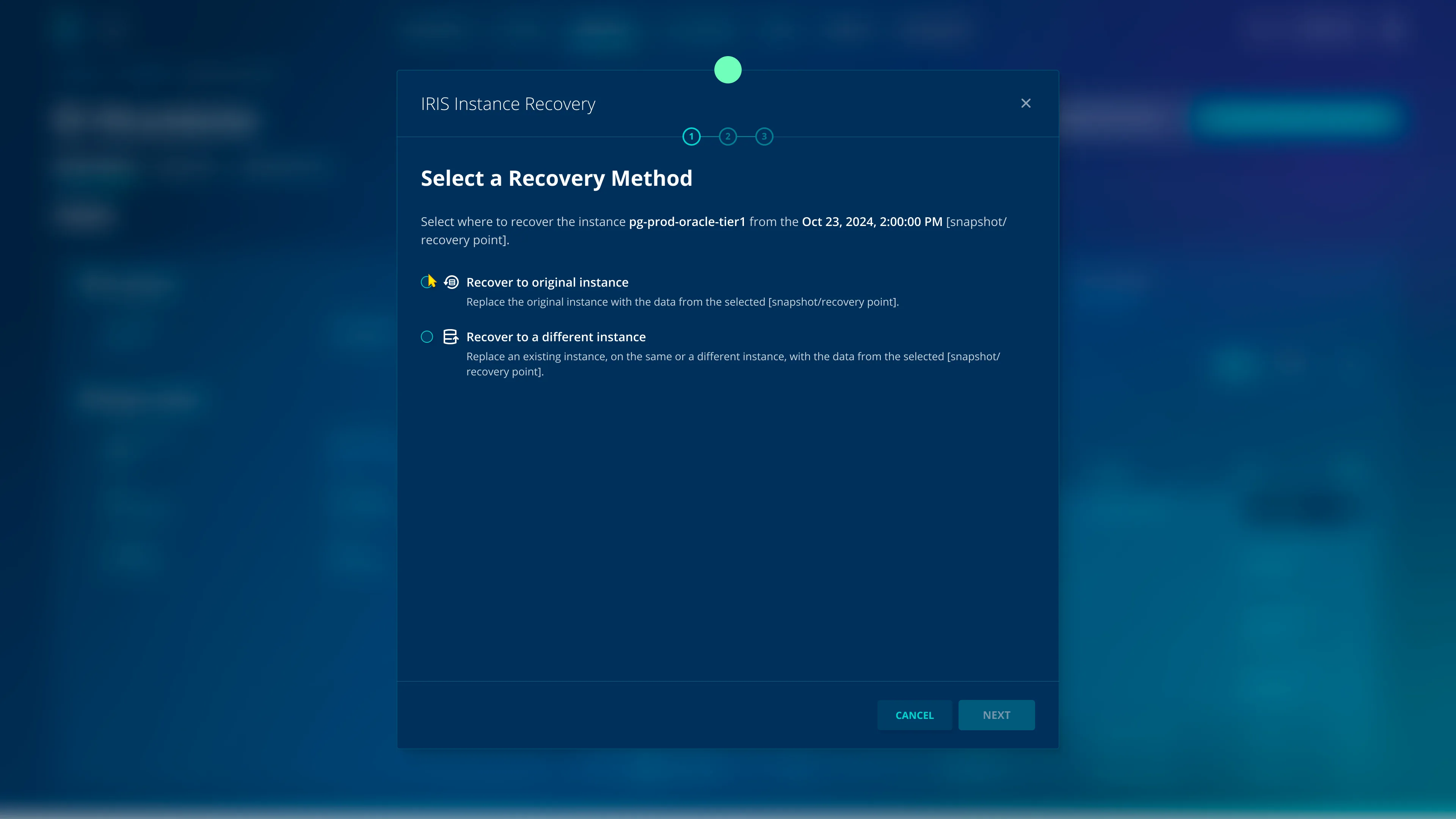
Epic environments often depend on InterSystems IRIS. Its recovery model differs from the Oracle and Db2 sources Rubrik already supports, so the first design task was to map the unfamiliar objects and decisions into patterns customers know.
I own the design for the IRIS snappable. I wrote the insights and design briefs, then built a nine-screen prototype in our codebase from the existing Db2 flow. The prototype runs in the development environment and keeps the recovery steps familiar while exposing IRIS-specific detail.
IRIS remains a prototype, so the visual represents the proposed recovery flow rather than a shipped feature.
Giving MongoDB backups a safe node preference
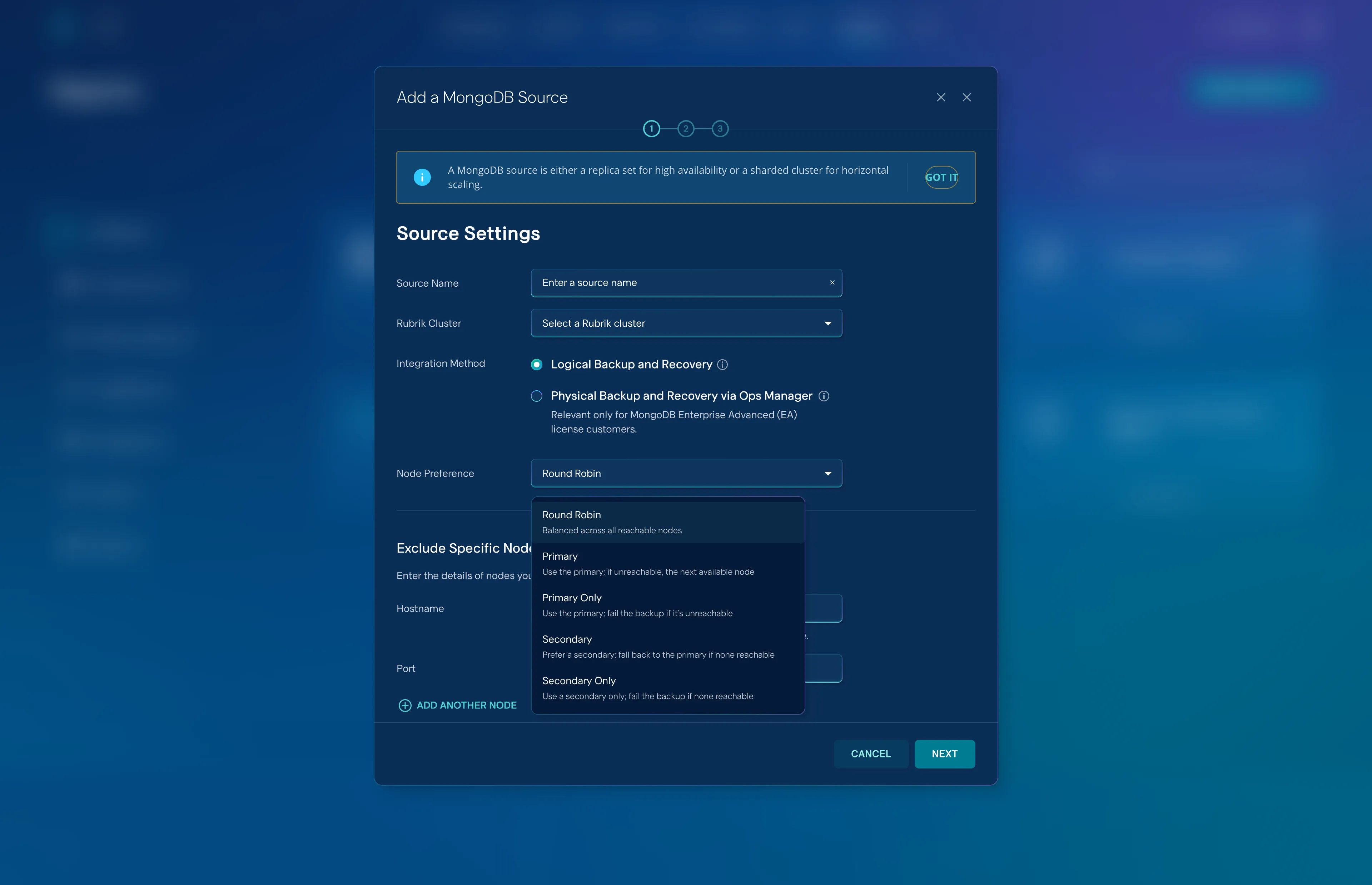
Topology-aware node preference. In design.
MongoDB runs as a cluster, and the node used for a backup affects load on live traffic. I designed a preference model that lets teams choose where a backup reads from without hiding the trade-off.
The design has five read modes, with round-robin as the default. I kept the setting per source rather than per policy, tied options to node roles so they remain meaningful as the cluster changes, and made Secondary Only fail clearly instead of silently falling back to primary.
This work is in design. The screen shows the preference control and the decision points it exposes.
Making GCP BigQuery permissions easier to reason about
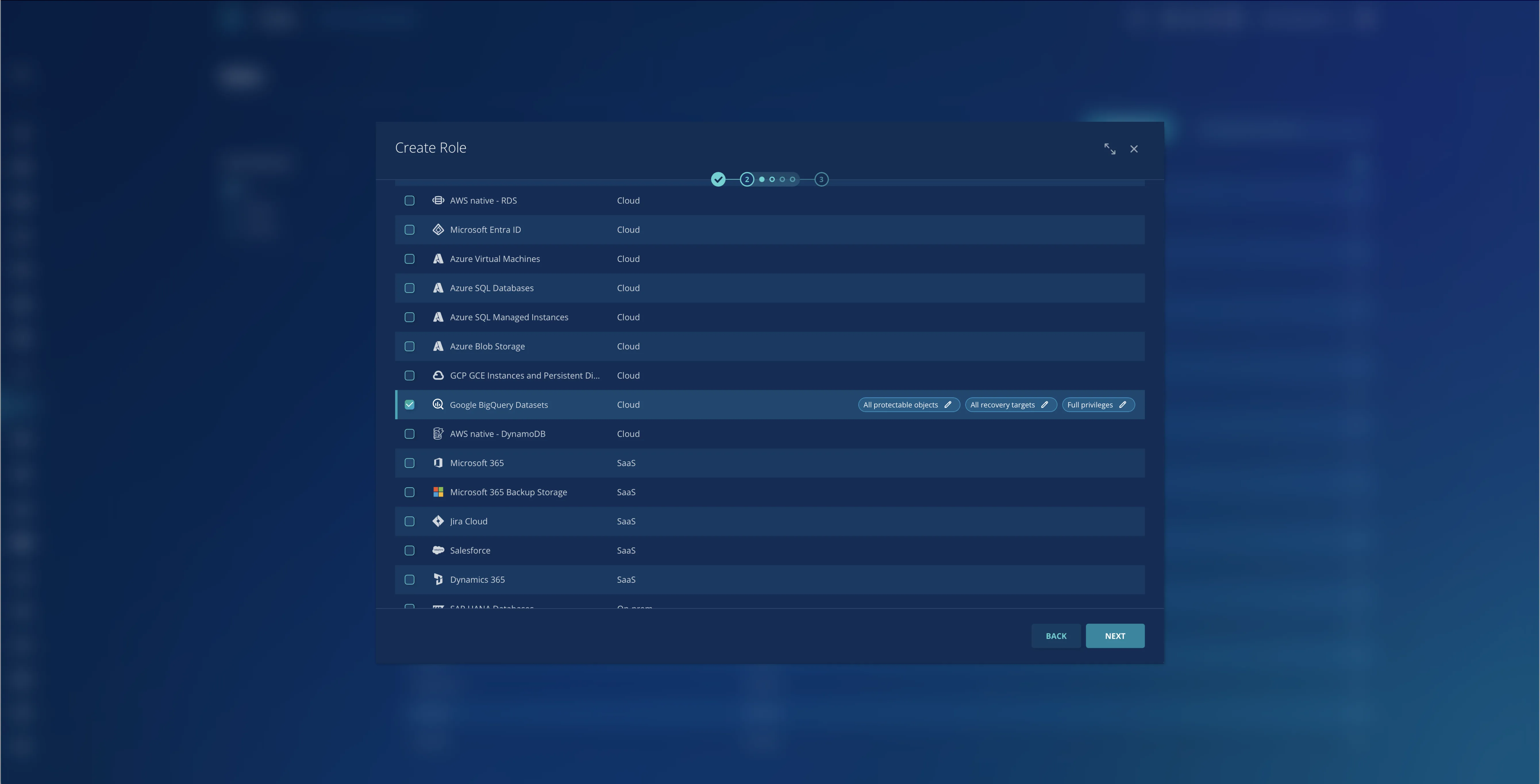
GCP BigQuery onboarding and role creation. In development.
Cloud permissions combine dense choices with high consequences. For Rubrik's GCP BigQuery support, I designed the onboarding flow and a role-creation wizard.
The wizard uses templates to keep most people out of the full complexity, privilege tiles to make scope legible, and a clear path to confirmation. Four high fidelity screens are designed within a fourteen-screen mapped flow.
The work is in active development, and the onboarding flow has passed security review.
Recognition
Feedback from managers and cross-functional leaders.
Spot bonus
For the IRIS snappable, DevOps Project Assets work, and the AI workshop. June 2026.
Leading our AI charter
Recognition from the VP and head of global design for the design tooling. June 2026.
Named on the GA launch
The company-wide DevOps Protection launch credited me by name on UX. May 2026.
Database lead from the UX side
How my manager described my scope across the database vertical. June 2026.